Chapter 1: Steal Like an Artist
If we’re free from the burden of trying to be completely original, we can stop trying to make something out of nothing, and we can embrace influence instead of running away from it.
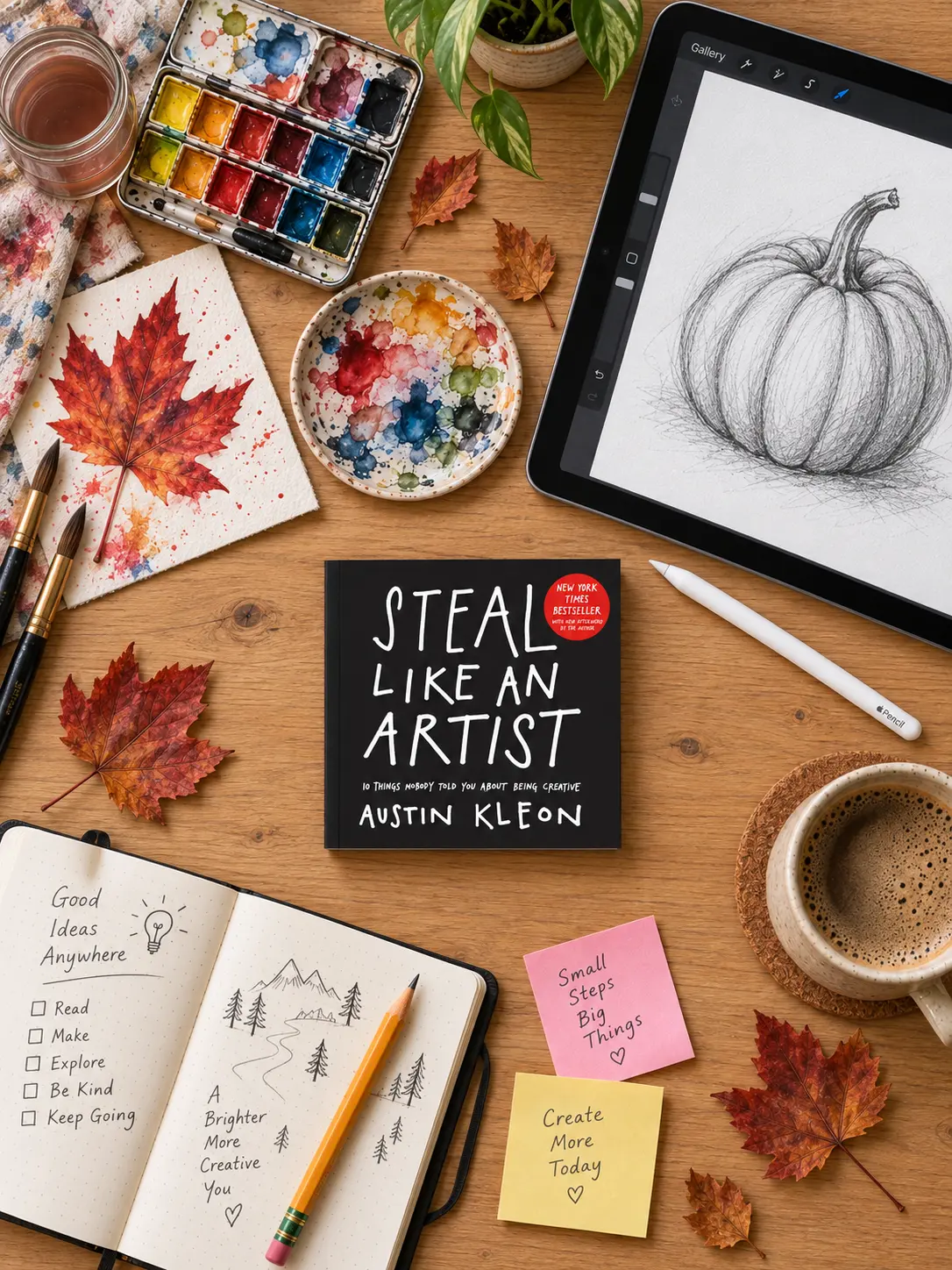
I’m starting a series of reviews about the books I’m reading, beginning with Steal Like an Artist: 10 Things Nobody Told You About Being Creative by Austin Kleon.
Although I’ve heard about this book many times, this is my first time actually reading it, and it found me at exactly the right moment. I’m currently trying to figure out what comes next for both my career and my creative life. No pressure, just a couple of small existential questions.
I’m a serial hobbyist. I knit, draw, read, and regularly become interested in something new. I’ve become reasonably good at many things without ever feeling that I’ve mastered any of them. I think part of the problem is the pressure I put on myself to be original. Instead of giving myself permission to learn through imitation and experimentation, I expect a fully formed personal style to appear immediately, preferably with excellent branding.
My professional life has been stuck at the opposite end of the spectrum. After 15 years in product design, I’ve spent the last four or five years doing familiar work in familiar ways, with very little outside influence. I remember how inspired and excited I felt at the beginning of my career, but much of that joy has gradually disappeared.
The arrival of AI in the technology world feels like an opportunity to change that. It has made design feel open and interesting again, and it may be the spark I need to rediscover my enthusiasm for product design and perhaps for my other creative pursuits as well.
What “Stealing” Actually Means
My main takeaway from the first chapter is that creative growth requires deliberately exposing yourself to influences you admire.
“Stealing,” in this context, is not about plagiarizing someone’s work and passing it off as your own. It’s about studying other people’s ideas and processes, filtering them through your own experiences, and allowing that combination to become something new.
That distinction gave me an unexpected sense of freedom. I don’t have to create in isolation to prove that I’m original. I can explore how other people work, borrow techniques, follow my curiosity, and see what emerges.
Rebuilding My Influence Tree
One of the book’s exercises is to build an “influence tree.” When I read that passage, fa whole bunch of people immediately came to mind.
My first professional step will be to reconnect with these people, revisit the course materials, and learn more about their processes and influences.
Having 15 years of experience does not mean I should have everything figured out. If anything, it has made me realize how many opportunities to learn from others I overlooked during the last five years. Experience, apparently, does not exempt anyone from doing their homework.
Applying the Idea Beyond My Career
I want to take the same approach with my creative hobbies.
I’m fascinated by Scandinavian knitting, particularly Danish patterns. I plan to research the designers I admire, follow their work, study their methods, and knit some of their patterns. By understanding how they make decisions, I hope to develop the confidence and knowledge to eventually create designs of my own.
Drawing is another important area for me. I’ve always loved it, but I haven’t drawn consistently in 10 or 15 years. Its absence has left a noticeable gap in my life.
Until now, I’ve followed artists online without giving myself permission to study their techniques. I thought I needed to invent my own style from scratch. This chapter helped me see that exploring another artist’s process is not the same as copying their work. It is simply a way to learn.
I don’t have a detailed plan yet, but I’ll begin by reviewing the artists I already follow, choosing one whose work resonates with me, and experimenting with their techniques without expecting every sketch to reveal my artistic destiny.
Starting a Swipe File
The most practical habit I want to adopt is carrying a notebook and using it as a “swipe file”: a collection of ideas, observations, references, and anything else that catches my attention throughout the day.
I love this concept, although I also slightly dread the habit-building required to remember the notebook, take it out, and actually write in it. I value convenience, so I’ll start with a physical notebook but remain open to using my phone when that feels more realistic.
The format matters less than the act of collecting. I often have ideas that feel memorable in the moment and then disappear completely, as if my brain has quietly cleared its cache without consulting me. Capturing those thoughts will give me a personal archive of inspiration to revisit and build upon.
My Takeaway
The first chapter of Steal Like an Artist reminded me that creativity doesn’t develop in a vacuum. It grows through attention, curiosity, practice, and engagement with the people and work that inspire us.
For me, the next step is not to force originality. It is to become a better student: to reconnect with people I admire, study the work that excites me, collect ideas as they appear, and give myself permission to experiment.
Perhaps originality isn’t where the process begins. Perhaps it’s what gradually emerges after we’ve paid close attention to everything that moves us.